


On October 27, Civics Day NJ SUB/URBAN REVIEW convened its second Bloomfield Avenue is a Commons event. At the Newark Public Library a 3-practice discussion was held with community members regarding their thoughts on Route 21/MacArthur Highway in Newark. Bloomfield Avenue is a Commons explores the street as a commons. The Commons is an institution.
“Many policy prescriptions are themselves no more than metaphors. Both the centralizers and the privatizers frequently advocate oversimplified, idealized institutions—paradoxically, almost ‘institution-free’ institutions.” From Elinor Ostrom’s Governing the Commons (1990).
It offers a more liberatory way to describe the often-captured idea of “safe streets,” a description of which tends to lend itself to negation bias and dehumanizing actions and strategies.
SUB/URBAN REVIEW kicked off the Bloomfield Avenue is a Commons idea on October 15 with the premiere of Close Encounters of the 34th Avenue Kind, a documentary by Clarence Eckerson Jr., at Montclair State University.
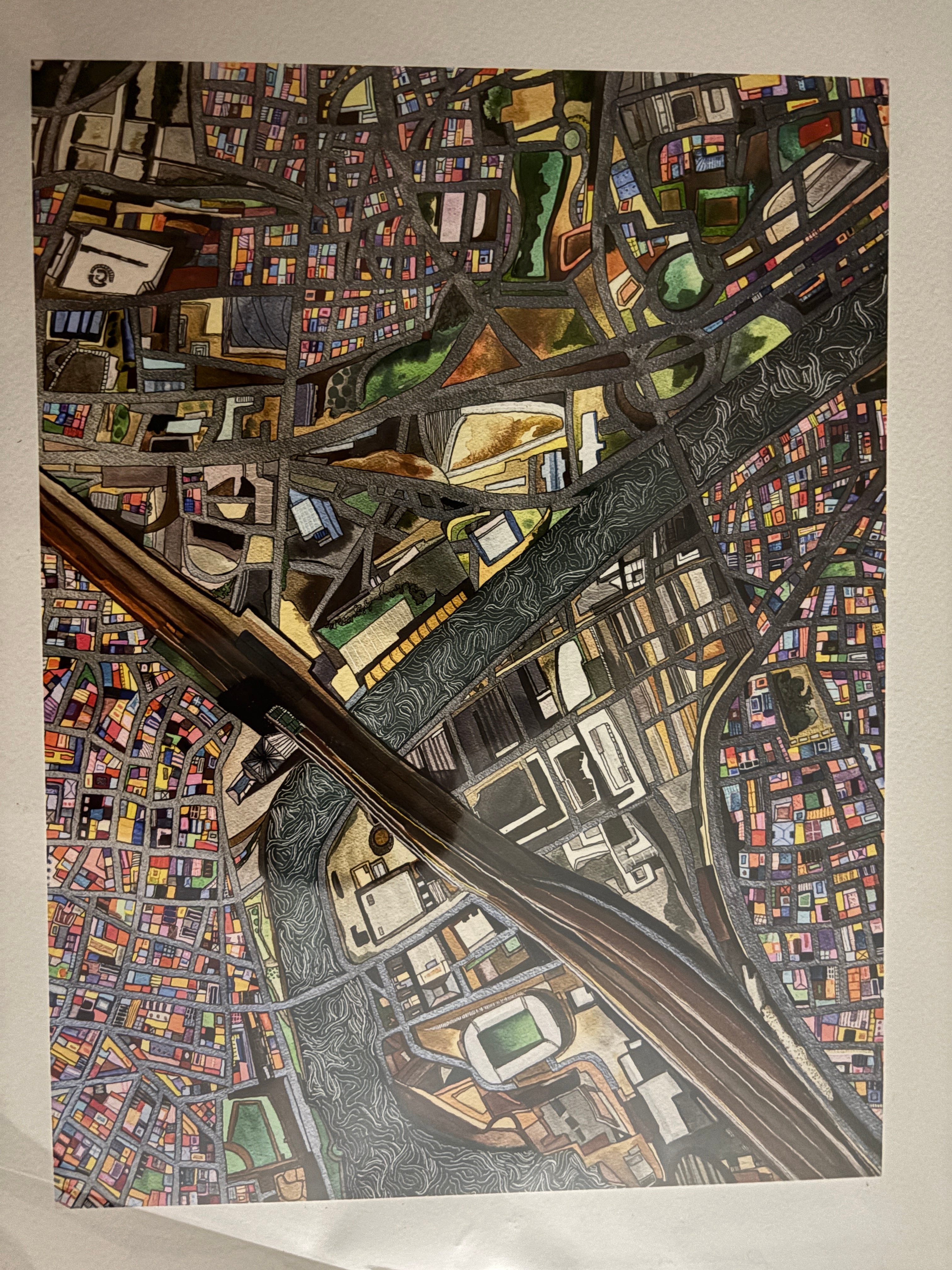
Using the prompt What does Route 21 make you feel and a print of East Orange Manufacture Village artist Sandra Charlaps’ painting Harrison & Newark, New Jersey (22”x30” watercolor & ink on paper) we embarked on a 3-Practices discussion.
The 3 practices are rooted in the following:
I’ll be unusually interested in others.
I’ll stay in the room with difference.
I’ll stop comparing my best with your worst.
We shared our thoughts on Route 21 and also shared our ideas on how to make it more of a Commons for the City of Newark and Harrison.
While Bloomfield Avenue is one of the most dangerous streets in culturally suburban North Jersey; Route 21/MacArthur Highway is one of the most dangerous streets in urban New Jersey; in fact, Route 21/ MacArthur Highway is one of the most dangerous roads in the entire state, alternating between first and second place with the 280 (which also goes through Newark), depending on which way the wind blows, and bad design crashes people.
One discussant explained, “It floods, it’s very scary.” And another discussant stated, “Maybe more lanes would make it better.”
3-practice is not a debate, and at the end of 3-practice you still won’t agree. Still, you will come out with clarity of what your neighbor, colleague, friend, or family member thinks about an idea, and it may be very different than what you think. Yet, at the end of the day, we still have to work together and understand people; not agreeing with them is part of the foundations of cooperation and building a society.
“Instead of there being a single solution to a single problem, I argue that many solutions exist to cope with many different problems.” From Elinor Ostrom’s Governing the Commons (1990).