


New Jersey e-bike laws are the result of disaster patriarchy. The surge in bicycle takeovers, often involving e-bike speeding and lawlessness—these are not pathologies of cycling culture. These are symptoms of a political economy that remains invested in keeping people in cars. It is the natural progression of the roadie.
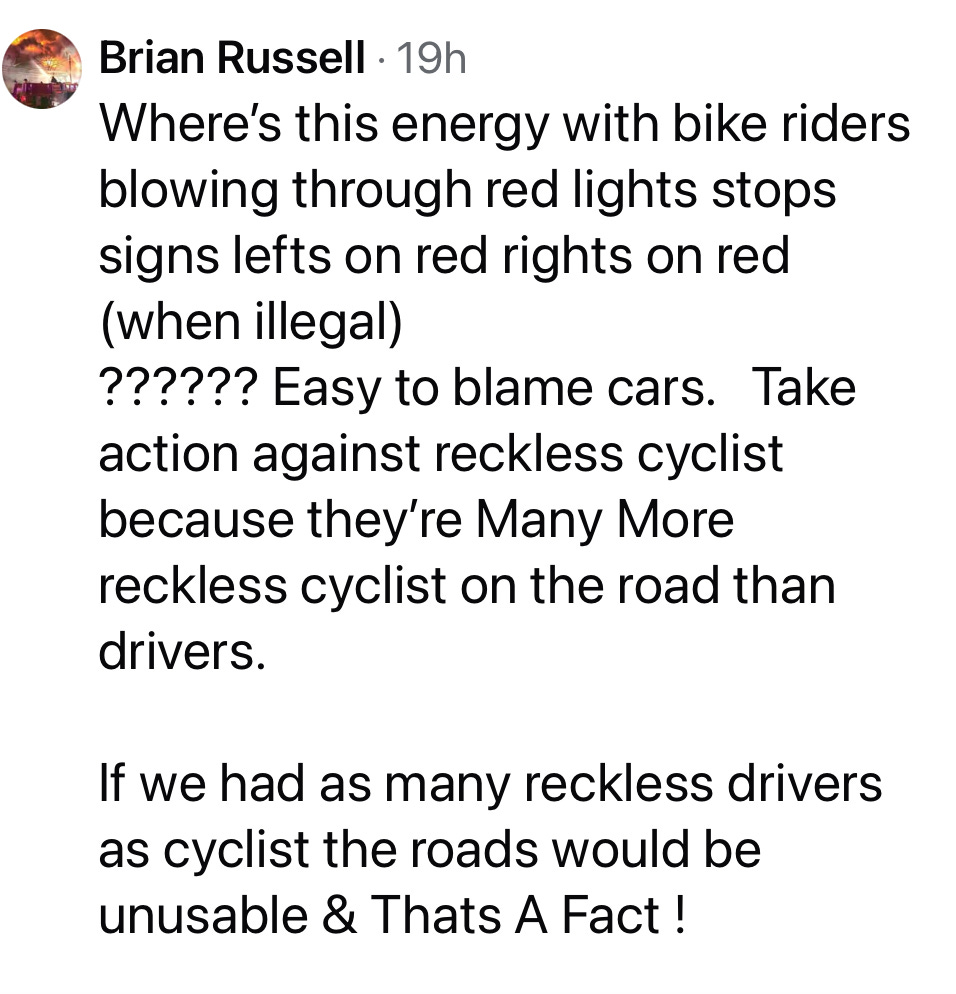
From Bloomfield Pulse
How “Greed is Good” Gordon Gecko Capitalism brought about gangster rap and justified “The War on Drugs.” Hegemony works in not-so-mysterious ways. In the late 1970s and early 1980s, hip-hop was explicitly political with cooperative tones, but this was not useful to hegemony, so instead they amplified violent and hyper-individualist sounds —its architects preached self-sufficiency and a brutal, patriarchal -capitalist ethos—so too does our transportation system reward aggression and spectacle. When you refuse to build safe, dignified alternatives, the streets become arenas. And arenas produce warriors, not neighbors.
Streets are not neutral paths. A community grounded in mutual respect, care, and cooperation builds infrastructure that reflects those ideals. Currently, our streets are designed so that public space is a pedagogy of power. Our streets say this person in a two-ton car belongs and anyone else is a hindrance to capitalism. It uses negation communications to say “you’re vulnerable,” so we should NOT make a space for you; your existence makes exploitation vulnerable and liable.
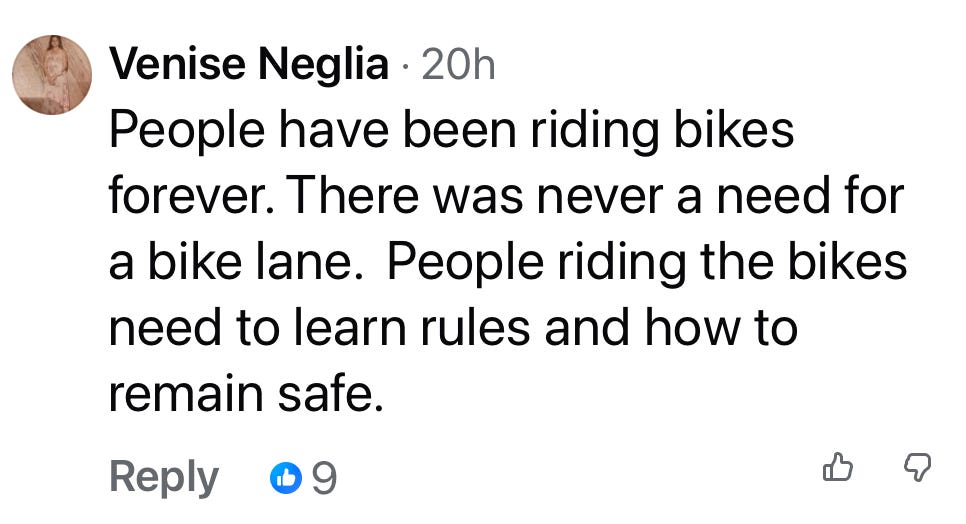
For over half a century, U.S. transportation policy and much of bicycle advocacy being captured by lawyers, roadies, and men who love market individualism have defaulted to the logic of “vehicular cycling.” Vehicular cycling is a framework pushed by John Forester. Its deceptively simple premise is that bicycles are vehicles. Seems liberating, but like faux meritocracy, it is only liberating for the privileged few who don’t need rules, because they are armed with 21 mph pace, a high STRAVA score, platinum health insurance, and a lawyer on speed dial— hell you are a lawyer.
Owing to this, cyclists must survive through skill, which can be obtained via a LCI, certified by the League of “We no longer subscribe to Forester —- we love you, try Waymo” American Bicyclists, assertiveness through the Chicago School, and individual vigilance ala boot straps. And under this sadistic regime (and plenty of protein powder), the preferred remedies are legalistic, meaning scientifically unproven three-and four-foot passing laws, helmet mandates, enforcement cameras (that has helped in throwing people in concentration camps); they are punitive rather than structural. The state allocates liability, not safety, to the working class. Protection remains privatized, not socialized.
While this appears to be a natural or a neutral technical choice, it is neither. It is an ideological project under the guise of common sense. It plants market logic into the soil of mobility. The burden of safety falls on the cyclist’s body and the car driver’s insurance premium and court-appointed lawyer, not on the collective’s investment. The question shifts from “How shall we protect one another?”to “Can you hold your own?” Failure is framed as personal inadequacy (sometimes driver and sometimes cyclist), not infrastructural failure.
And there are consequences. In the US, we have a cycling culture that rewards risk tolerance and aggression. If you ride with more than one man, at least one will confront at least one person, typically working class, to assert dominance: “Move your damn truck.” And sneer as they whiz past a double parked Amazon driver. Riders are trained to treat the street as a contest—a kind of transportation Dune where the spice flows only for the fierce. The implicit command is unmistakable: be tough, take the lane, or stay home.
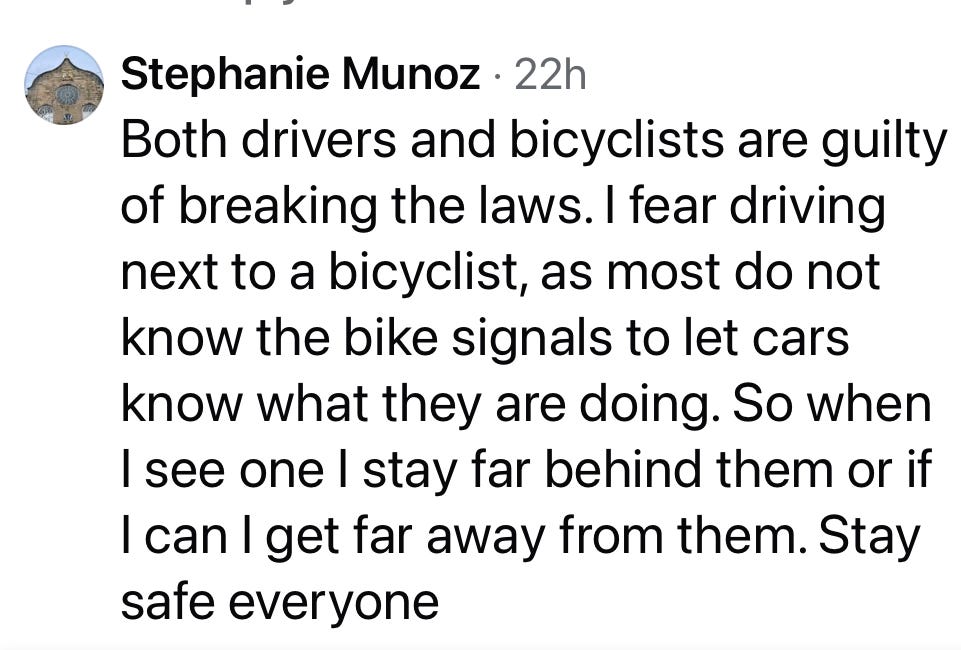
But there is another philosophy of the street; we only have to look across the street or rather, the pond.
In Europe, transportation infrastructure has a different weltanschauung. To use one’s bike is ordinary, not extreme. Protected lanes, traffic-calmed streets, and continuous networks loudly say that children belong here. Elders belong here. New riders, parents with cargo, disabled people, people running errands—we all belong on the street. The system is not designed to sort the brave from the timid. It is designed to maximize participation. Its success is measured not by speed records but by demographic breadth.
Bike lanes are social institutions. They are part of the social contract that in the United States is frayed. Their purpose is not for safety, an idea that I have grown to loathe. Protected infrastructure does more than prevent crashes; it cultivates a different political imaginary—one rooted in cooperation rather than competition, care rather than conquest. It makes mutualism legible and routinized.
This is not about cyclists being “nicer.” It is a structural claim: environments produce subjects. When you design roads that force cyclists into continuous high-stakes conflict with two-ton automobiles, you should expect the resulting culture to be defensive, aggressive, and exclusionary. When you empower disaster patriarchy you create a system where we must be saved by dominant men.
It DOES not have to be this way. There is another path.
If we want a bicycle culture that is welcoming, prosocial, and genuinely democratic, we must build for it.
That means aesthetically beautiful and pragmatic protected pedestrian and bicycling networks, low-stress street designs, and public policies that lower barriers to entry—not just for the lycra-clad or the worked tied to the algorithm, but for the elderly, the disabled, the young, the anxious, and the ordinary women.
I am not asking what kind of cyclists we want, but what kind of community do we want to develop and live in. Bike lanes are one way we answer that question, because if they are built well, they become institutions of solidarity. Built poorly, they remain monuments to a politics we claim to have outgrown, like Forester. The choice is ours, and it is material. We can continue to empower extractive market-based ideas or we can break from the pack and empower community and the choice is really ours.