


Dorothy Parker allegedly said that Los Angeles is “72 suburbs in search of a city.” As a fifth generation Angeleno, I am going to have to reject this assertion. Los Angeles is a city, just one with contradictions inside and out. I spend much of my work life in New York, a place that US urbanists uphold as the gold standard for functional density.
As a bicoastal sub/urban critic married to a Midwesterner, a one-seat train ride into Manhattan in a North Jersey suburb, a place with a small yard, and a cat who takes walks on a leash, I am always searching for the answer to the question:
How should we arrange human space?
That question was a third wheel on my trip Chautauqua.
What I noticed when I first arrived was that I could hear. I could hear cicadas and the birds chirping. I also could hear conversations.
My headphones exist to drown out the city and to keep strangers away. I didn’t feel the urge to put on my headphones to drown out noise or to keep away strangers
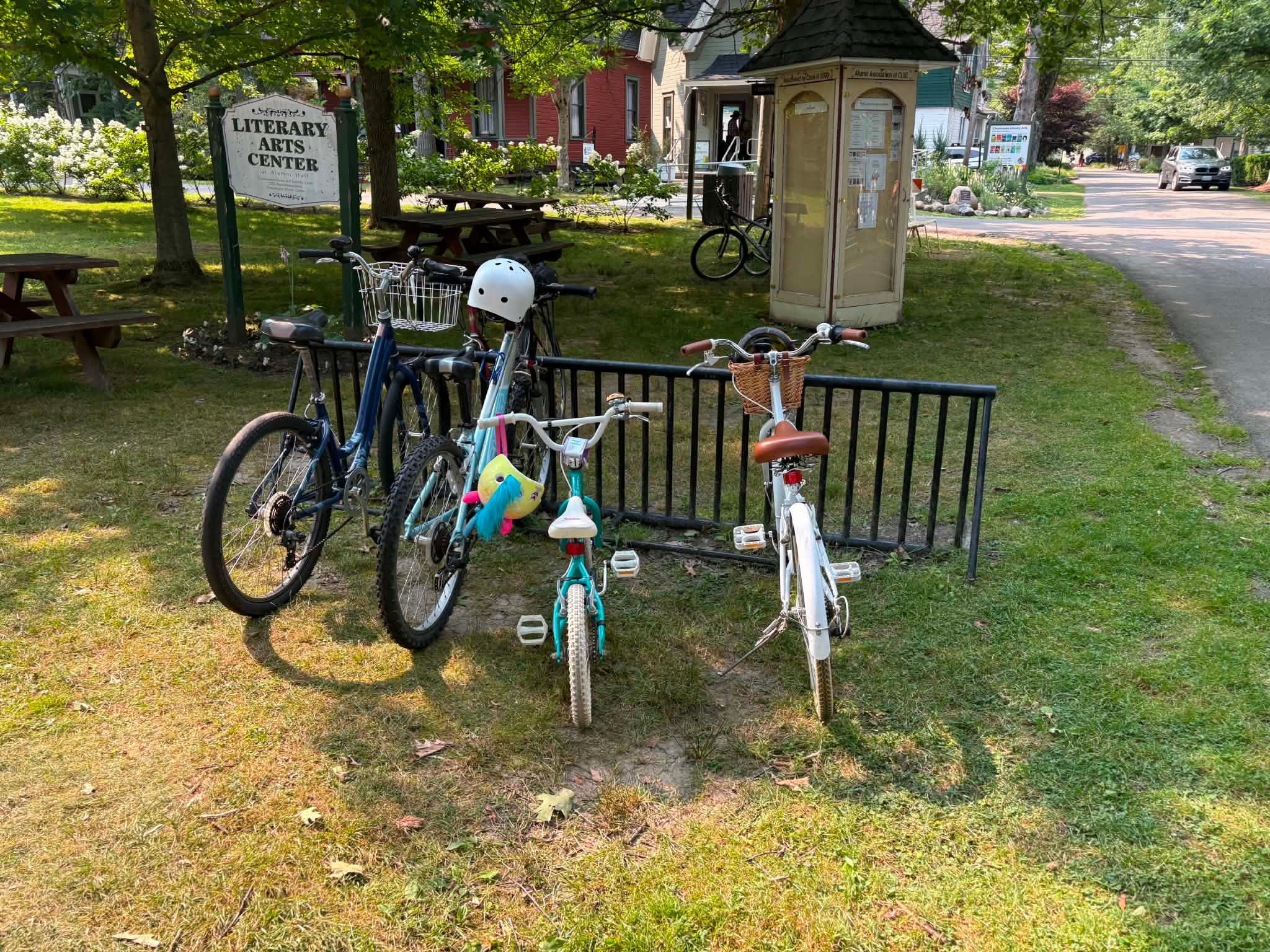
On the grounds people shared. Tricycles and mobility scooters shared paths with electric bikes and walking sticks. Children practically danced with their bicycles while their grandparents wandered between the trees. The Chautauqua Symphony performed, and its Opera, the oldest continuously producing summer opera company in the United States, staged works by Debussy & Mozart. People talked to one another on porches and outside the library.
And there was quiet stillness that I didn’t know existed outside of turn of the century Victorian novels.
And it wasn’t creepy stillness like when you wake up in the middle of the night like you forgot something, but the kind of stillness when you’re out in the middle of nowhere, but this is definitely somewhere, and now I remember! There was music, laughter, and squirrels walking right up to you as if to say, “Can you spare some ice cream?”
But this place was carlight, practically carFREE.
Cars are funny that way. You don’t notice how busy and annoying they are until they are gone.
I rented a house about five miles down in Mayville and bicycled to the Institution each day. The bike lane connecting it to Chautauqua, I am going to politely call it, aspirational. It was mostly a highway shoulder separated from traffic by a line of paint and a prayer. As truck (drivers) threatened my life, I couldn’t even hear my audiobook, David Sloan Wilson’s The Neighborhood Project, a book about how communities shape human behavior.
That is not written for effect.
You know what, though, the moment I entered the grounds of Chautauqua, the difference was a good reminder. Stripping away the automobile changes what people pay attention to and how they feel. People stop and look at one another. People actually talk to you, like so many people said hello to me, and I’m new at Chautauqua, and with my gigantic curly hair, I stand out.
But when people talk, even a little, they begin to know one another.
When they know one another, they begin to care about one another.
In the United States, we spend large clumps of time discussing what is broken and wrong. We debate polarization, loneliness, and the erosion of trust. We publish reports and commission studies. We all like to diagnose on our social media accounts:
“It is the parents, mom probably.”
We rarely talk about places that work, like Chautauqua.
And this place works! Not because it’s completely shielded from reality as it has not escaped the challenges of modern America, but it does work because it creates the conditions that turns strangers into neighbors.
One afternoon, I was working outside the bookstore, and was getting a good rhythm on my laptop. Then I stopped. I heard some music. This couple was playing folk music, one on an accordion and the other on a fiddle. The man reminded me of my preschool teacher, Mr. Garless. Mr. Garless who would randomly break out his accordion to sing the clean-up song or make up a song with your first name. I placed my glasses on the bench and headed off to the amphitheater for an opera performance.
Halfway through the evening, I realized why the subtitles were so blurry and then in my head, “Oh no, MY GLASSES.” Oh well, my glasses were gone, yet again, or so I thought.
Gone not owing to some nefarious purpose, but because people, when they are in a hurry and the night is ending they have to get home and that’s two buses away. People clean, and things get thrown in the trash or put in a bin of lost items that has ten years of stuff, because that is too far of a drive to go back ... .who wants to go figure that out? I don’t.
The next day I returned because it was a good spot to people-watch, and there they were. Folded neatly on the bench exactly where I had left them.
Lots of people had to have passed by the bench. Some had to have noticed them and sat next to them, but you know what, person after person made the same tiny decision. These aren't mine, but they belong to someone. They will probably be back, so I’m going to leave them here.
It seems silly, but it wasn’t silly. It said something about the social infrastructure.
As a sub/urban critic and a political economist, me and my friends talk a lot about social capital and trust. We debate theories and build models to explain why so many places do not work.
My glasses being on that bench is a reminder that the the best places are filled with countless tiny acts of care by regular people.
Chautauqua is not populated by saints. It is not about the perfect, yet it is perfectly ordinary. It is about the ordinary.
My glasses were on the bench because Chautauqua is set up in a way that gets people comfortable with sharing their physical and social space.
Being in a place on the timeline where everything appears a mess, trust and neighborliness are among the most important forms of infrastructure that we can build, and we CAN build it.