


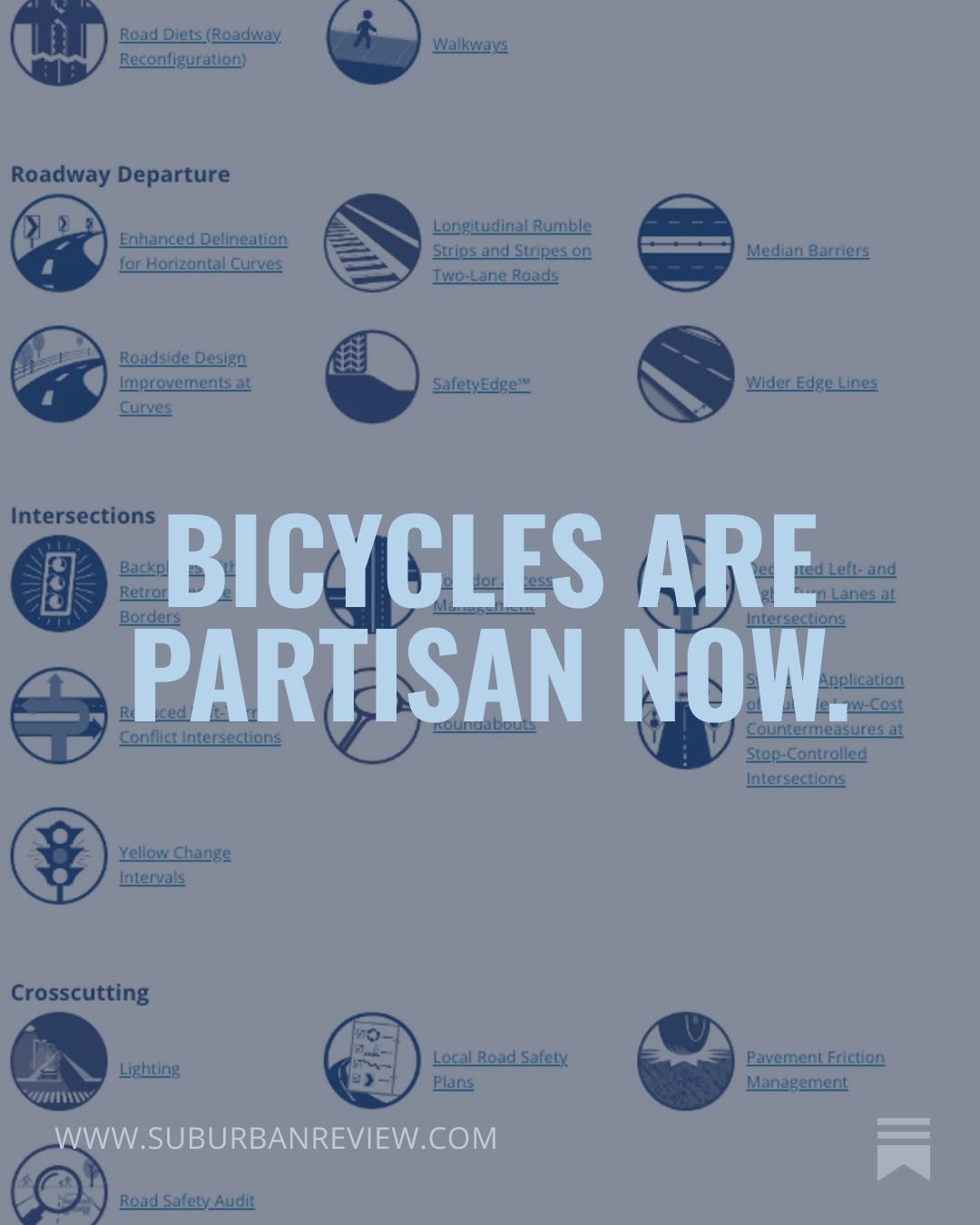
USDOT removed “bike lanes, road diets, and every major speed-management” strategy from a list of proven safety countermeasures. They did it with a website edit, and they didn’t even bother to change the copy.


The partisan in bicycling is not about blue or red. Bicycles are partisan because they shift power from corporations and toward ordinary people. Protected bike lanes, slower streets, and road diets redistribute public space from auto asphyxiation to earth & anthropocentric metrics. This is a political choice.
Bicycling’s primary purpose isn’t health, and it is also not recreation. All of that was a lie, a nonpartisan guise, but we see now they know, they have always known, and it is time we fight back instead of continuing to acquiesce to power.
Proven methods do not disappear overnight, while the public is told nothing has changed. This is not neutral and it is definitely not a mistake.
Proper bicycle advocacy is not about transportation. It is about social relations and public infrastructure. The lesson I want to stress is that transportation is political and bicycle advocacy must be accountable to people, not business lobbies. For years, many advocates treated cycling as a bipartisan or post-political issue, assuming that if the data were strong enough, corporate and political elites would support safer streets. That is not how this works. The quiet removal of bike lanes, road diets, and proven speed-management strategies from USDOT’s safety guidance should end that illusion.
If bicycles are about democratizing mobility, reducing dependence, and giving ordinary people greater freedom over their daily lives, then bicycle advocacy must be willing to challenge power when power turns against those goals. Your business lobbies have never cared about the people. Uber Eats does not care about delivery drivers; they are now using the bike lanes WE fought for, for robots.
Demand the same accountability from advocacy organizations that we demand from elected officials. Elected officials get their information from advocacy, and if advocacy is acting like a poorly paid lobbyist, we get bike lanes for drones and 12-year-olds on 40-mile-per-hour electric bicycles with no helmets.
Too often, neoliberal politics has taught us to trust experts, branding, and partnerships while neglecting the need to build independent public power.
When institutions can discard proven safety measures with a website update and no public explanation, the response cannot be deference or ignoring, because we need to keep our funders happy. Your funders brought you here, and many of you deep down know this.
What are the potential results of this? By removing bike lanes, road diets, and speed-management strategies from federal safety guidance, USDOT creates uncertainty for planners and advocates who rely on federal best practices to justify projects. It also will make it harder for communities to compete for grants or even defend people-centered street designs.
Bicycling is not neutral. At its best, it is about empowering people over systems that prioritize speed, profit, and control. Advocates need to start acting like it.