


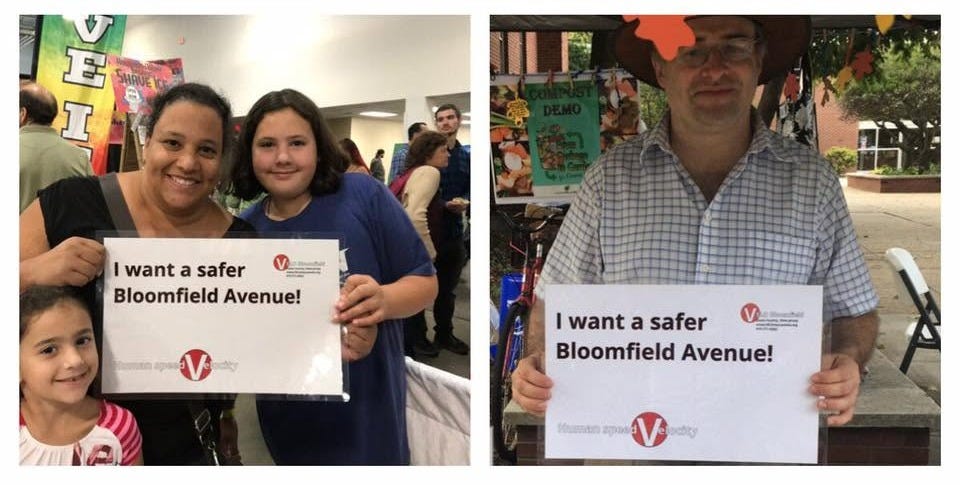
A week ago, a member of VELO Bloomfield was riding on Bloomfield Avenue near Grove when a driver struck her.
We will identify her anonymously as Citizen Jane due to the ongoing investigation into the crash.
What she remembers most is not just the impact, but the realization that her life could have changed in an instant, just because she wanted to be carFREE.
“I have been carFREE for about 6 months now. I wanted to have a more environmentally friendly way to get around and also be able to get around on my own time, because the bus is hit or miss.”
Like many people who ride bicycles in Bloomfield, she was not training for a race or in a park, as it is illegal to ride your bike in Essex parks. She was simply trying to get around her community. The same street that thousands of residents drive every day became, in a matter of seconds, a place of danger.
For many cyclists, stories like this are all too familiar. Yet the crash raises a larger question that extends beyond any one rider: What kind of street do we want Bloomfield Avenue to be?
For years, local officials, planners, business owners, and residents have talked about making Essex more walkable, more vibrant, and more welcoming. Bloomfield Avenue is the spine of that vision. It connects West Caldwell, Caldwell, Verona, Montclair, Glen Ridge, Bloomfield, a tiny bit of Belleview, and our heartbeat, Newark.
It connects neighborhoods, schools, parks, transit, and businesses. It is where many of the townships’ daily interactions take place.
But it is also a road that many residents say feels unsafe to bicycle on.
“I don’t think paint or the 4-foot laws are sufficient. We need physical barriers between bikes and cars. I get the impression that car drivers are frustrated when they share the road with a bike because a human-powered bike does not go nearly as fast as a car, and no one is going 25-mph-on Bloomfield Avenue. We need scientifically proven traffic calming.”
Citizen described the emotional post-crash as being just as important as the physical one. The road is a commons. Riding a bicycle requires a sense of trust, trust that drivers will see you, that roadway designs account for your presence, and that the local government has considered your safety. Once that trust is broken, getting back on a bike can feel daunting.
Her experience is not simply an individual story. It points to a broader challenge facing Essex County and communities across North New Jersey.
Recently, VELO Bloomfield conducted a community survey , that included participaction of 16 cities across the Metro in North Jersey (13) and NYC (3), regarding a protected bike lane on Bloomfield Avenue. The results were striking: approximately 90 percent of respondents supported the idea and this survey included a substantial N.
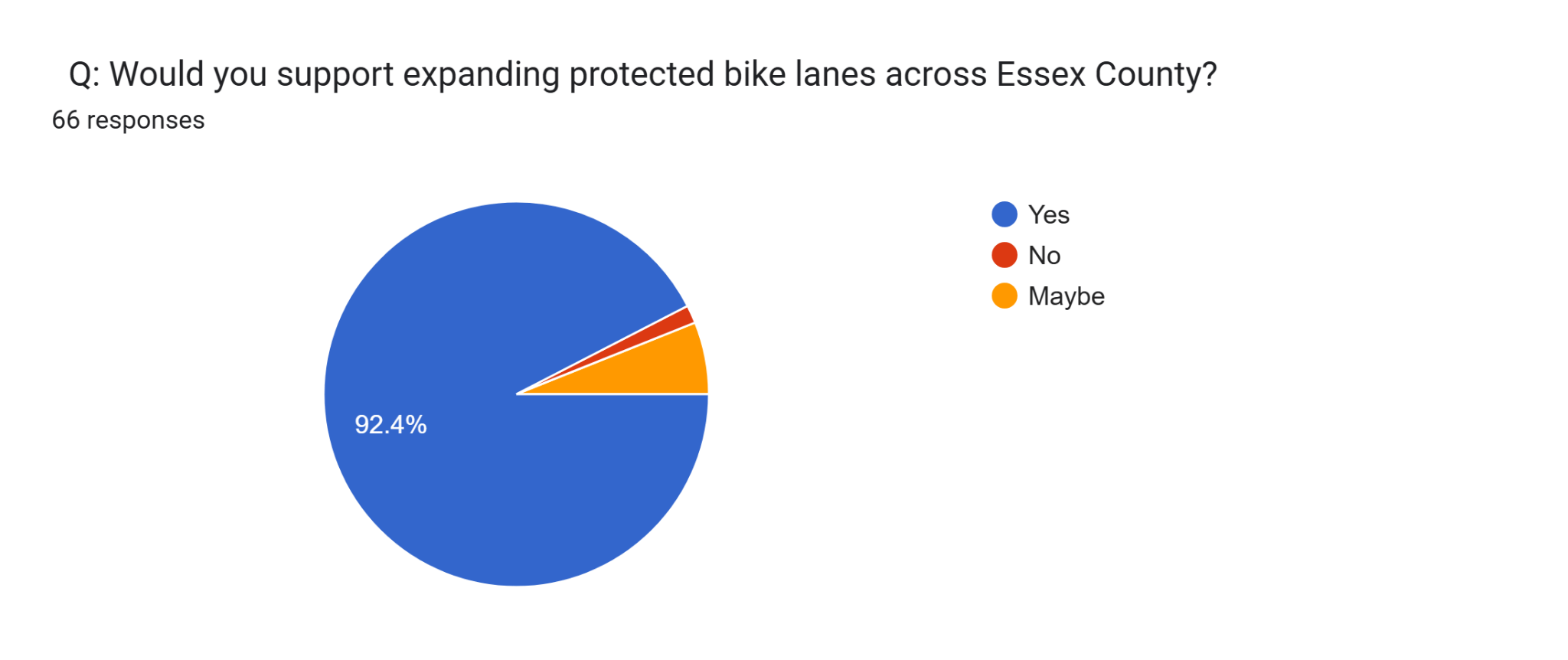
That level of support suggests that residents are not asking whether improvements should happen, but how they should happen.
The organization has since launched a petition outlining a community vision for what a Bloomfield Avenue bike lane could look like. Rather than treating bicycle infrastructure as an afterthought, the proposal imagines a safer street where people walking, bicycling, taking transit, and driving can coexist more comfortably.
Auto Asphyxiation often describes bike lanes as taking away needed parking and harming business, or a cheap way for unsavory outsiders to come in; both are false. Transportation researchers and planners have long shown that good bicycle networks that strengthen the community are networks that ordinary people in your neighborhood feel comfortable using. Meaning you create the cyclists that you want, you want risk takers, build risky bike lanes, you want soccer moms to use it, then create a bike lane that is accessible to her.
“If we’re going to have a bike lane, we need to actually have a bike lane that goes for more than a block and that’s the bare minimum. I understand that these things cost money, but I feel like if there is a will there is a way. I’m happy to pick up some tools.”
One of the most overlooked aspects of the transportation conversation is gender.
Across North America and Europe, studies have consistently found that women are underrepresented among people who bicycle on high-stress roads. The reason is not a lack of interest. In many cases, women report concerns about safety and traffic conditions. When protected bicycle facilities are installed, the number and diversity of cyclists typically increase.
“I’m a licensed psychologist, and I chose to switch from a car to a bike, because driving a car is stressful and expensive, and keeping me poor. “
That observation should matter in Bloomfield.
Many of the newest riders seen on local streets are women, like Citizen. Some are returning to cycling after years away from a bicycle.
Others are using bikes for everyday transportation. Some are parents. Some are students. Some are trying to incorporate physical activity into their daily routine.
All of them deserve infrastructure designed with their safety in mind.
If a street feels safe only to the most confident riders, it is not truly safe.
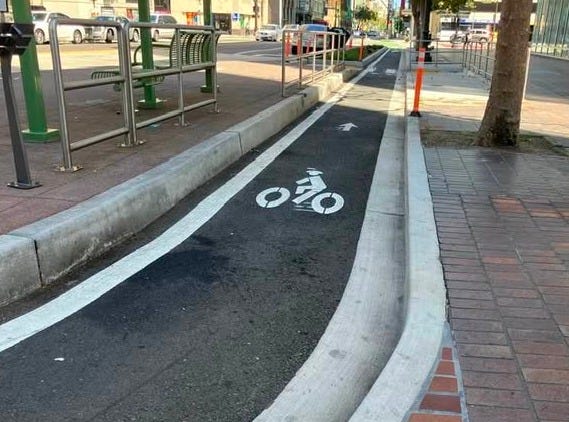
“This is what we need on Bloomfield,” Dr. Susana Sotillo, Emeritus Montclair State University on the community group page Space is a Means of Production, a group dedicated to prosocial methods and the climate crisis.
The question Bloomfield faces is therefore larger than whether a bike lane should exist. The question is who the street is designed for.
Is Bloomfield Avenue intended primarily for moving automobiles as quickly as possible? Or is it intended to function as a community corridor that supports local businesses, neighborhood connections, and multiple ways of getting around?
The proposed bike lane offers one answer. Creating a dedicated space for cyclists would reduce conflicts between bicycles and motor vehicles, improve comfort for new riders, expand transportation options for residents who cannot or prefer not to drive, and create a prosocial commons environment on Bloomfield Avenue.
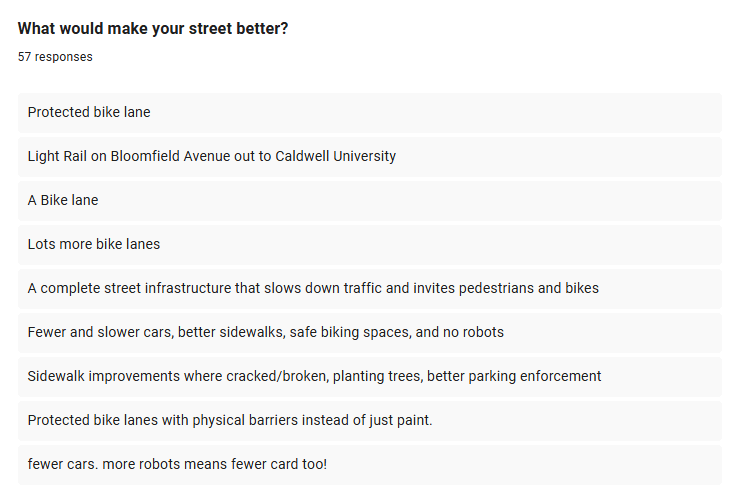
The proposal also aligns with broader goals that Essex has embraced for Bloomfield Avenue in recent years: safer streets, stronger downtown businesses, environmental sustainability, and more transportation choices.
No infrastructure project can undo what happened to the cyclist who was struck. A bike lane cannot erase the fear that follows a crash.
But communities show their values through the choices they make after tragedies occur. This is a near tragedy. Disaster patriarchy pushes the idea that death is the only thing that can motivates change; feminist urbanism pushes against that idea. We don’t need a death to fix this.
The story of one rider being run over on Bloomfield Avenue is ultimately about more than a crash. It is about whether residents should have to accept that level of risk as the cost of riding a bicycle.
Survey respondents have expressed overwhelming support for change. Residents have signed petitions. Cyclists have shared their stories. Community members have offered a vision of a safer Bloomfield Avenue.
The question now is whether state, county, and congressional leaders will listen.
Because the real issue is not whether Essex can build a bike lane on Bloomfield.
It is whether Essex County and the towns connected by Bloomfield Avenue are willing to create a street where cycling is a practical and welcoming option for everyone, from children and families to older adults and first-time riders.

Editorial Note from VELO Bloomfield

At VELO Bloomfield, we believe every resident deserves the freedom to move through our community carFREE.
The story you have just read is painful because it is personal. One of our members was struck by a driver while riding on Bloomfield Avenue. We are grateful she survived. No one should have to experience that kind of trauma simply for choosing to travel by bicycle.
But this is not only her story.
It is the story of many residents who say they would like to bike more often but do not feel it is safe or accessible. It is the story of parents who want to ride with their children, older adults who want alternatives to driving, students trying to reach school, and neighbors who would choose a bicycle for short trips if our streets felt welcoming. Increasingly, it is also the story of women and beginning cyclists who are discovering the joy, independence, and practicality of riding a bicycle but are confronted with roadway conditions designed primarily around automobiles.
The purpose of sharing this story is not to assign blame or inflame division. Our goal is to ask a simple question: What would it take to make Bloomfield Avenue safe and accessible for everyone?
We believe the answer begins with protected bicycle infrastructure.
Through our recent community survey, approximately 90 percent of respondents supported a bike lane on Bloomfield Avenue. Residents have continued that conversation through a petition that outlines a vision for what a safer, more comfortable street could look like. These responses tell us that support for safer cycling is not a niche concern—it is a broadly shared community priority.
A protected bike lane is not merely an accommodation for people on bicycles. It is an investment in a healthier, more connected, more prosocial, and more accessible Bloomfield Avenue, which is common to the “City of Essex.” It is a statement that our main street should work for everyone who uses it.
We invite students, residents, business owners, community organizations, foundation-funded and grassroots advocacy groups, as well as elected officials at the congressional, county, and local levels to engage with the proposal. Please reach out to us so we can review the survey findings and join the conversation. Great streets are not built through conflict alone; they are built through prosocial methods, public participation, listening, and collective vision.
We owe it to our injured member—and to everyone who wishes to travel safely on Bloomfield Avenue and in Essex County—to act before another crash becomes a more tragic story.
VELO (BIKE) Bloomfield
VELOBloomfield@gmail.com
Building towards the idea of Bloomfield Avenue as a commons where everyone in Essex County can access carFREEdom.
Disclosure: Lo Sontag, the writer of this piece is the founder of VELO Bloomfield.